PNG – Lukluk long bihaintaim bilong PNG ikonomi, em I Moa Nogut insait long olgeta kantri bilong Ist Esia

World Bank em I bin givim niupela updet long lukluk long bihaintaim bilong ikinomik bilong ol kantri insait long Saut-Ist Esia na Pasifik – lukim hia. Dispela pepa em I namba wan pepa long tupela bai I lukluk long dispela updet bilong World Bank

Stori bilong tingting long gro

Dispela stori, I luk olsem I no gutpela stori ol manmeri PNG bai I harim.

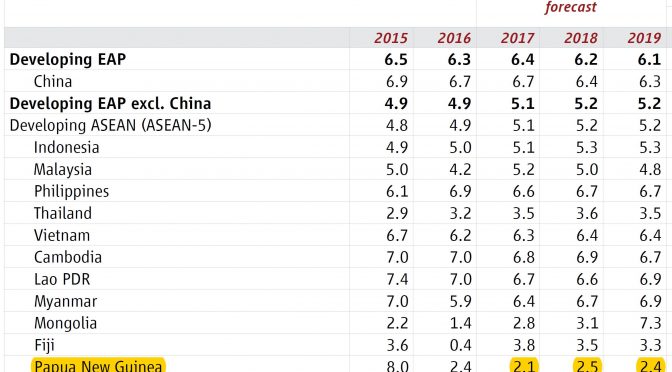
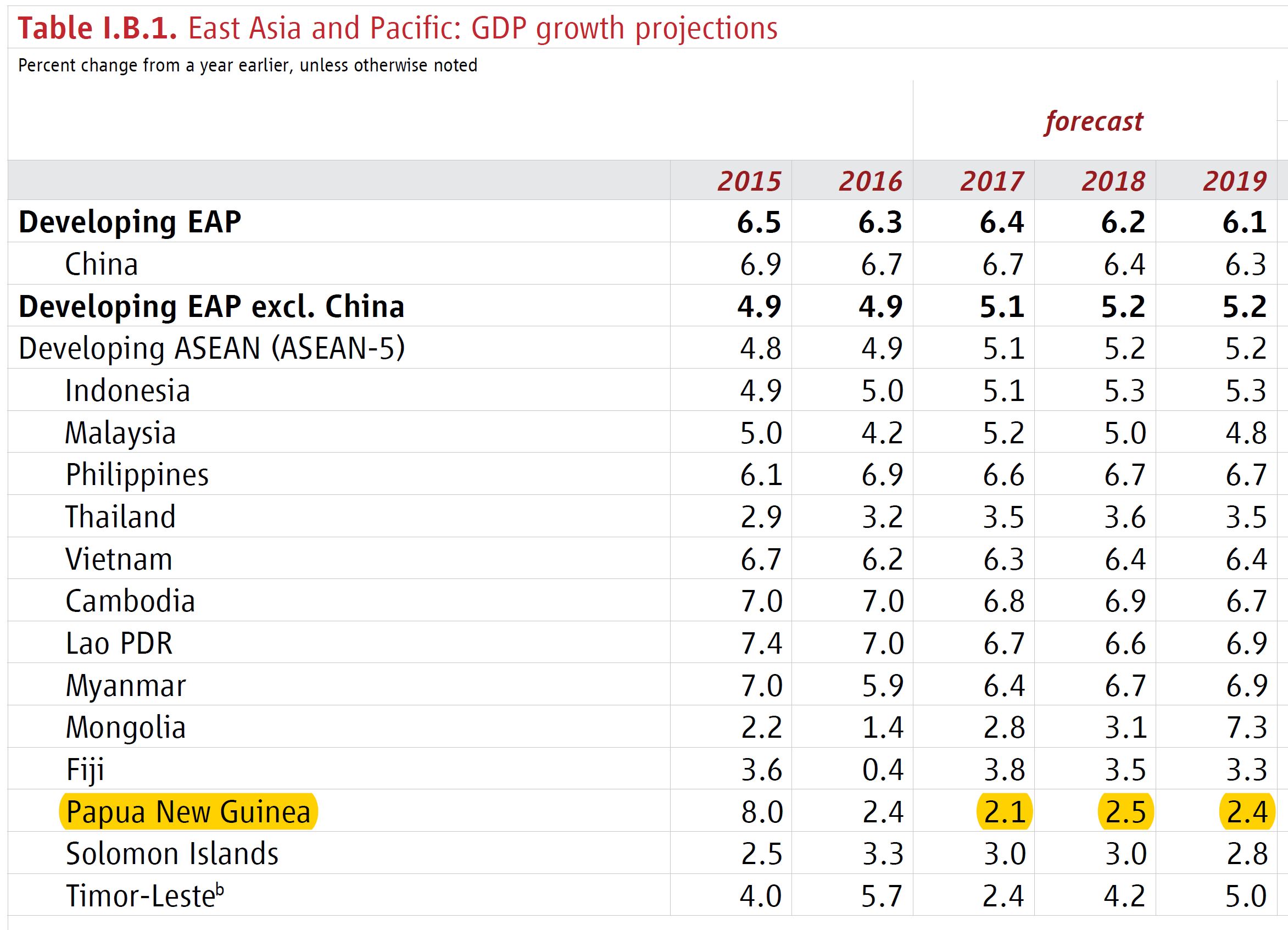
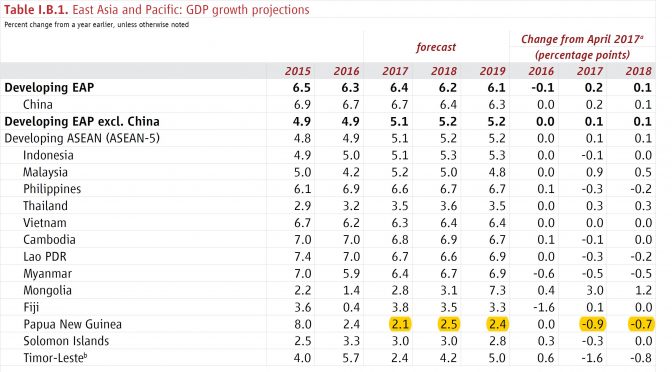
Ripot bilong World Bank I soim olsem, olgeta yia 2017 I go 2019, ol I ekspektim PNG bai kamap long las ples insait long olgeta kantri, daunbilo stret –( bai yu lukim tebol long p 30 insait long World Bank ripot. Lukim yelopela kala I soim ol namba bilong PNG I daunbilo stret. PNG bai I kam las wan stret )

 Tebol I.B.1 Ist Esia na Pasifik: tingting long gro long GDP

(% senis long yia bipo)
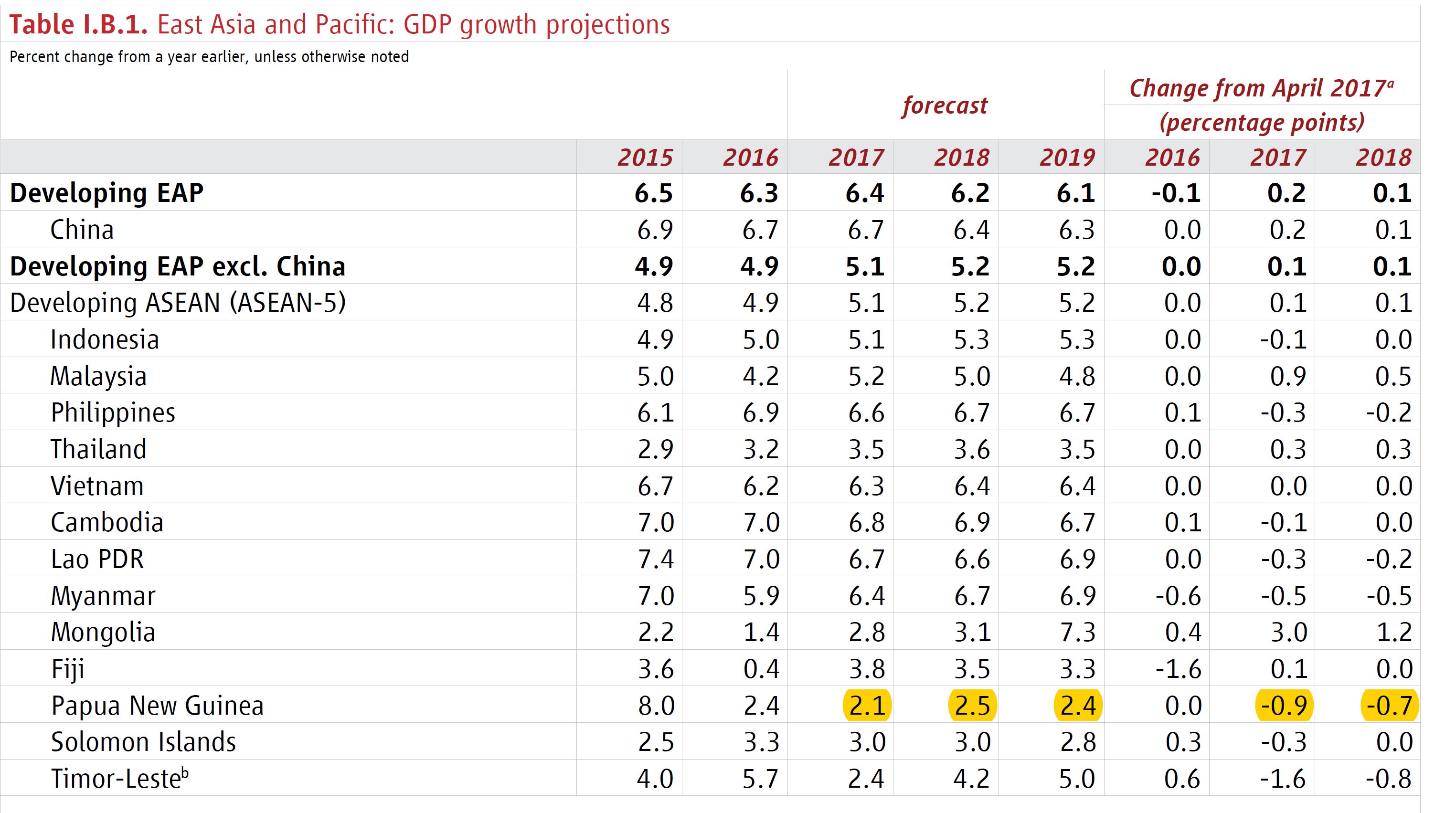
EAP – Ist Esian kantri I wok long divelop

EAP- Ist Esian kantri I wok long divelop, tasol China I no stap insait

ASEAN –  Asosiesin bilong ol kantri Saut Ist Esian


Ikonomik gro em bai  2.1 I go 2.5%, na gro bilong populesin em bai 3%, olsem ikonomik I wok long go bek, sapos yu lukim long wanwan man na meri PNG.

Las ripot World Bank i bin givim long April 2017, sixpela mun pinis. Taim yumi lukim dispela ripot na niupela ripot, yumi lukim olsem olsem, insait long niupela ripot, ol I makim gro bilong PNG I go daun long 0.9% long 2017, na go daun gen long 0.7% long 2018.

Dispela bikpela pundaun I kamap bihain long niupela O’Neil gavman I bin givim ripot long bung Alotau II , long 100-de plen bilong ol, na long Saplementari Badget.

Taim World Bank I kisim ol namba bilong PNG I go daun, ol I soim olsem ol I nogat gutpela tingting long dispel ol niupela polisi bilong niupela gavman.

Ol I tok olsem dispel “namel” gro bilong PNG insait long non-risos sekta, em I kam long sot bilong foren ekschenge, na tu olsem I kam long “fiskol konsolidesin”, olsem gavman wok long stretim hevi bilong planti mani ol I spendim na liklik mani tumas I kam insait.

Insait long nekst blog bilong mi, bai mi lukluk long niupela BPNG Moneteri Polisi stetmen, na bai mi toktok long nogut impekt bilong ol restriksin long foren ekschange ( na tu hau BPNG I laik haitim dispela).

Wanpela narapela samting olsem, taim engin bilong gro is bagarup,  inflesin tu em bai I go daun. World Bank nau I ekspektim inflesin bai I go daun long 4.1% tasol long 2017. BPNG em I tok inflesin bai I 6.0%.

2015 PNG LNG project I bin givim PNG namba wan ikonomik gro insait long Pasifik. Nau I luk olsem nogat moa gutpela win bai I givim pawa long PNG ikonomi.

PNG ikonomi I depend tumas long risos tasol. Sapos ikonomi bai I bes long planti narapela narapela sekta, olsem agrikaltja, grona divelopmen bai I gutpela moa long olgeta man na meri PNG.

Konklusen

Yumi lukim olsem wanpela narapela referi gen bilong ikonomik, World Bank, em tu em I wari long ikonomi bilong PNG.

PNG I nidim niupela daireksin long polisi bilong ikonomik divelopmen. Wanpela artikol I bin lukim long last 40 yia na I givim sampela sadgestin – lukim long hia, na tokples Inglish long hia.

Wanpela sadgestin mi givim insait long dispela analisis, em I olsem, yumi mas sanapim ol man na meri PNG namel stret long divelopmen. Tasol I no long agrikalja o turism tasol. Wei long wokim gutpela divelopmen, em I mas bungim na lukautim ol manmeri PNG.

Ol tred na sektorol polisi nau , ol I soim olsem gavman I save lukautim ol wantok bilong em yet, tasol I no save lukautim gut olgeta manmeri PNG. Olsem eksempol bilong banis long impot – olsem PNG I bin wokim long Ramu Sugar-  em I save bagarapim olgeta konsiuma. Dispela kain polisi I save bagarapim gro bilong ikonomik.

Charles Abel, niupela Tresara na depiuti Praim Minista em bai I mas makim gut wanem kain advais em bai I harim, olsem em I ken painim gutpela rot long ol manmeri PNG.

Yumi mas hopim olsem, 5 yia taim, PNG bai I gat ol namba wan namba bilong gro insait long Ist Esia-Pasifik, na ol namba bai I kam long narapela narapela sekta, I no mainim na LNG tasol.


PNG’s Sept 17 Monetary Policy Statement (3) – Dangerous complacency on private sector credit growth

Two previous articles have analysed the latest Monetary Policy Statement from PNG’s central bank – see here and here. Unfortunately, this is primarily a bad news story.

One final indication of how PNG’s central bank  is  failing the PNG people is its dangerously complacent view on appalling credit growth rates to the private sector.

The latest statement estimates private sector credit growth being 2.5% in 2017.  It then states “The Bank considers the projected growth in monetary aggregates sufficient to support the growth in the non-mineral private sector” (emphasis added).

However, 2.5% is much less than BPNG’s forecast of inflation of 6% in 2017 – so there is actually less real money available. Real credit growth is actually a negative 3.5%.

This negative real growth rate means less money is available to small businesses  for investing into agriculture and tourism. It means less money available for house buyers.

This is an extraordinary contrast to earlier Monetary Policy Statements.  For example, going back eight years to September 2009 when Sir Wilson Kamit was Governor of BPNG we get the statement: “Private sector credit is expected to slow further to 15.0 percent in 2009, as the increase in cost of borrowing will slow aggregate demand. This is considered sufficient to support economic activity” (emphasis added).

So in 2009, the private sector needed 15% credit growth to support economic activity.  In 2017, the view is that 2.5% credit growth is sufficient. (Inflation expectations in both years are either 6 or 6.5%.)

Something has gone seriously wrong with PNG’s model of development. The latest Monetary Policy Statement from BPNG reveals a dangerously complacent view about what is adequate to support the private sector. This is especially concerning given the way BPNG is underplaying problems facing the private sector through foreign exchange restrictions as well as its support for an explosion in growth to the government sector.

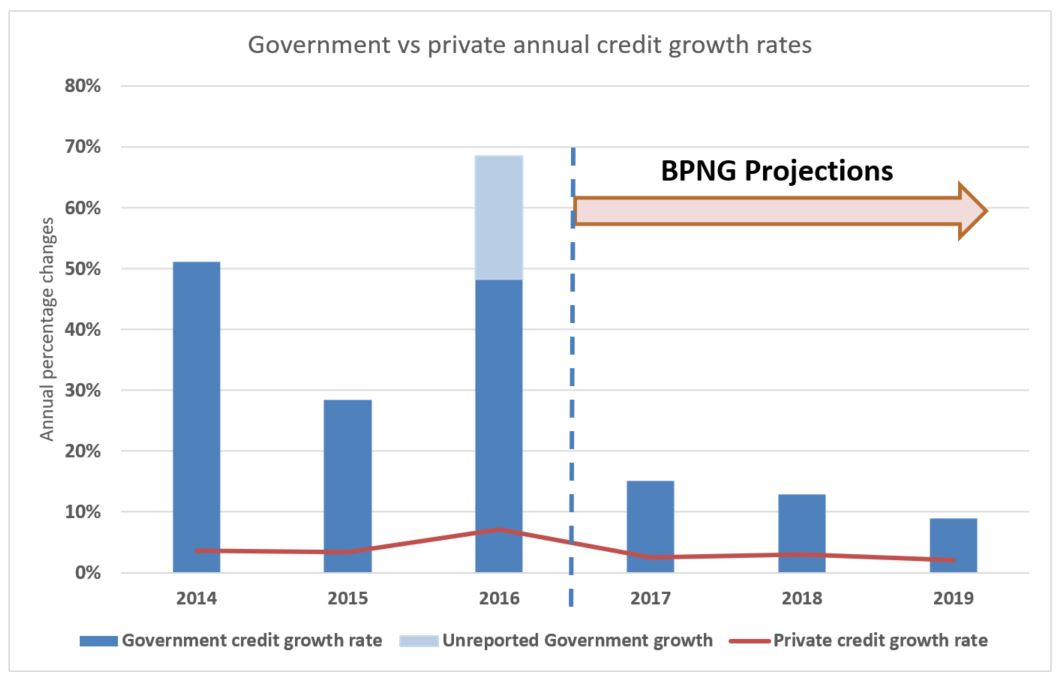
The extent of complacency is shown in the following graph.  This sets out annual credit growth rates to the private sector (the low red line) relative to the government sector (the very high stacked blue columns).  These figures are straight from Table 1 in the latest Monetary Policy Statement.

This shows how badly the private sector is doing relative to the government sector.

Indeed, things are actually worse. The 2016 growth rate in government sector credit is actually understated by 20 percentage points. Using the source material for the table (Quarterly Economic Bulletin Table 1.31, net claims on central government moved from K5,345m in December 2015 to K9,008.7m in December 2016, an actual annual increase of 68.5%, much higher than the already extraordinary 48.3% mentioned in Table 1).  This is shown by the additional light blue area in the graph for 2016 (figures for 2014 and 2015 were correct).

Future projections that the rate of government credit growth will slow down are also suspect.  For example, in the September 2016 Monetary Policy Statement, BPNG predicted the government credit growth for 2016 would be less than 2%.  It turned out to be 68.5%. The 2017 year projection of 15.1% is more realistic, but is almost certainly understated given the 2017 Supplementary Budget was not sufficiently credible in winding back the budget deficit to 2.5% of GDP (see here).

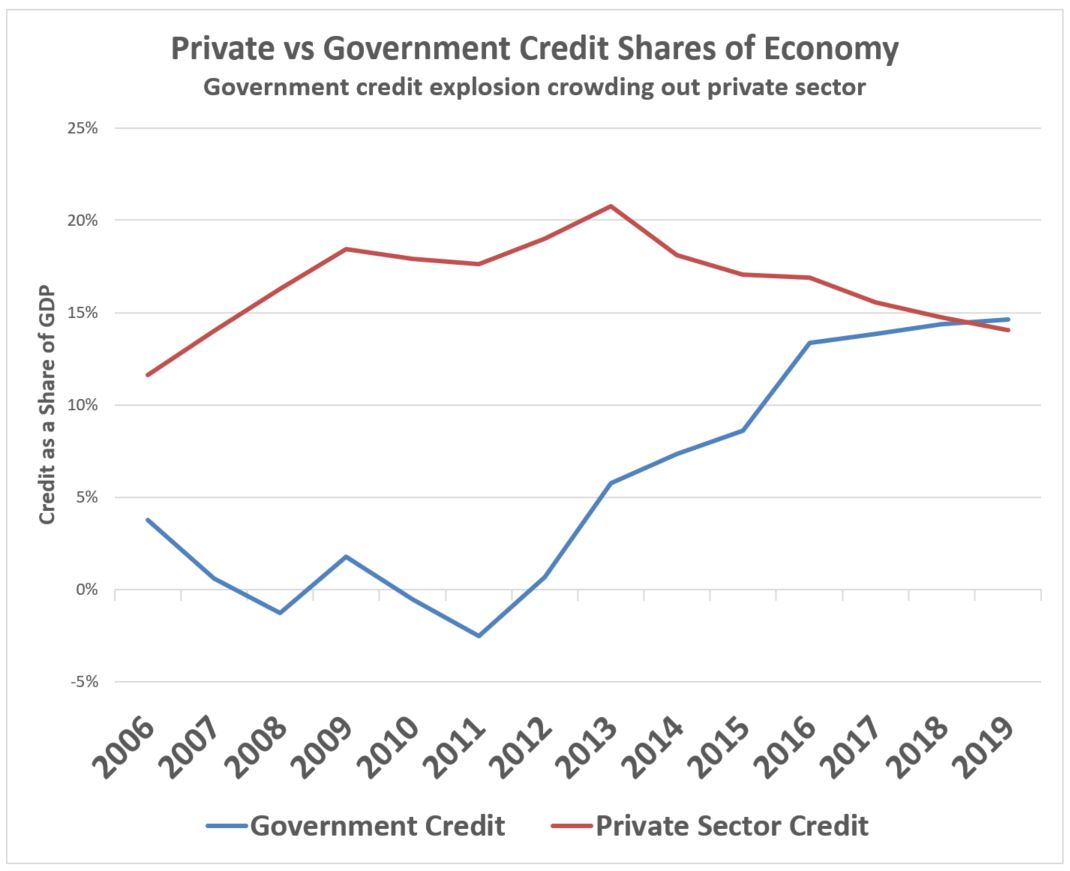
The following graph shows how credit to the government is growing very rapidly as a share of the economy, while credit to the private sector is falling.

The graph uses BPNG figures (from QEB Table 1.31) with the National Statistics Office figures of GDP.

As much of the government sector growth includes relatively inefficient expenditure (such as APEC and the South Pacific Games, as well as overinflated infrastructure contracts) this is not good for PNG’s economic growth prospects.

The falling share of private credit in the economy goes to the heart of a lack of confidence by local businesses.

PNG’s share of credit to the private relative to the economy are considerably lower than other Asian countries that really appear to value their private sector. Using World Bank data, PNG’s share of private sector credit to GDP in 2014 (latest comparable information for PNG) was just above the level for least developed countries, just over half the level for other lower middle income countries, just under half the level for Pacific island small states, and less than a quarter the level for East Asia and Pacific.

BPNG, and the government, needs to do much more to support private sector growth rates. In part, this will mean ensuring that there are sufficient funds to support bankable projects. This is getting harder because of the explosion in credit to the government.

Messages from PNG businesses need to be considered more closely by government. There are positive signs of increased consultation by the new Treasurer. Considerably more could be done to also improve PNG’s ranking on the Ease of Doing Business scores.

Conclusion

BPNG’s claim that private sector credit growth of minus 3.5% is “sufficient” is ridiculous for a country facing the worst economic growth prospects in the Asia-Pacific region – see here.

BPNG needs to adopt the policies that will remove PNG’s foreign exchange shortages. They need to stop printing money which allows the government to duck the hard decisions. They need to get more money flowing to the private sector to encourage investment and get people into housing.

BPNG needs to stop playing games with statistics and being complacent about the collapse in the private sector.

BPNG is failing to meet the valid expectations of the creators of an independent central bank – a lesson from the devastating economic crisis of the late 1990s.

This is the worst Monetary Policy Statement from the BPNG for more than a decade. Shame BPNG.

There are some great people in BPNG and it is hard to tell what has gone so wrong to create such a poor statement. One hopes the bank’s future actions will build on its excellent work on financial inclusion and start doing its part (along with the new Treasurer) in getting the PNG economy back on track.

PNG’S SEPT 17 MONETARY POLICY STATEMENT (2) – PRINTING MONEY EXPLANATIONS NOT CONVINCING

The Bank of PNG’s recent Monetary Policy Statement was the worst for more than a decade.

BPNG is trying to hide the truth that its monetary policy actions are killing growth prospects in PNG.

This is the second of three articles analysing the worrisome errors in the statement.

Pretending that printing money isn’t a problem by using erroneous statistics

In a second extraordinary attempt to justify its actions – see here for the first – BPNG argues “In light of the Government’s tight cash-flow and domestic financiers reaching their limit on sovereign exposure, the Central Bank had (emphasis added) to assist the Government by buying Government Securities (Treasury bills and bonds) when the auctions were undersubscribed.”  This was known as the “Slack Arrangement”.

Indeed, it is a very slack arrangement!

No central bank governor has to assist the Government in this way. There may be extraordinary circumstances when such actions become necessary. These could include financing during wartime, and possibly for dealing with a very short-term financing crisis with a known resolution. However, the fall in international commodity prices occurred three years ago at the end of 2014. PNG should have got its fiscal house back in order by now. Printing money takes the pressure off the government to make the needed changes – including putting in place better policies to get growth going again or reaching out to the international community for assistance.

What is even worse is that the Governor is pretending that there is not a problem. Indeed, he mischievously argues “The Bank has actively sterilised (emphasis added) this liquidity generated by the Slack Arrangement through on-selling of the Government securities and CBBs to the market.  As at the end of August, the Bank’s holding of securities (Treasury bills and bonds) under the Slack Arrangement was K1.600 billion. It has issued CBB and Tap totalling K1.588 billion.”

So the argument is BPNG printed K1.6 billion but then took almost exactly the same amount out of markets so there is no risk to the economy.

This is not true.

PNG’s monetary policy stance

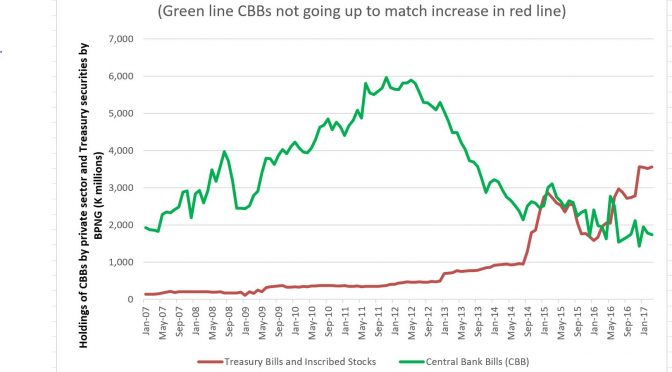
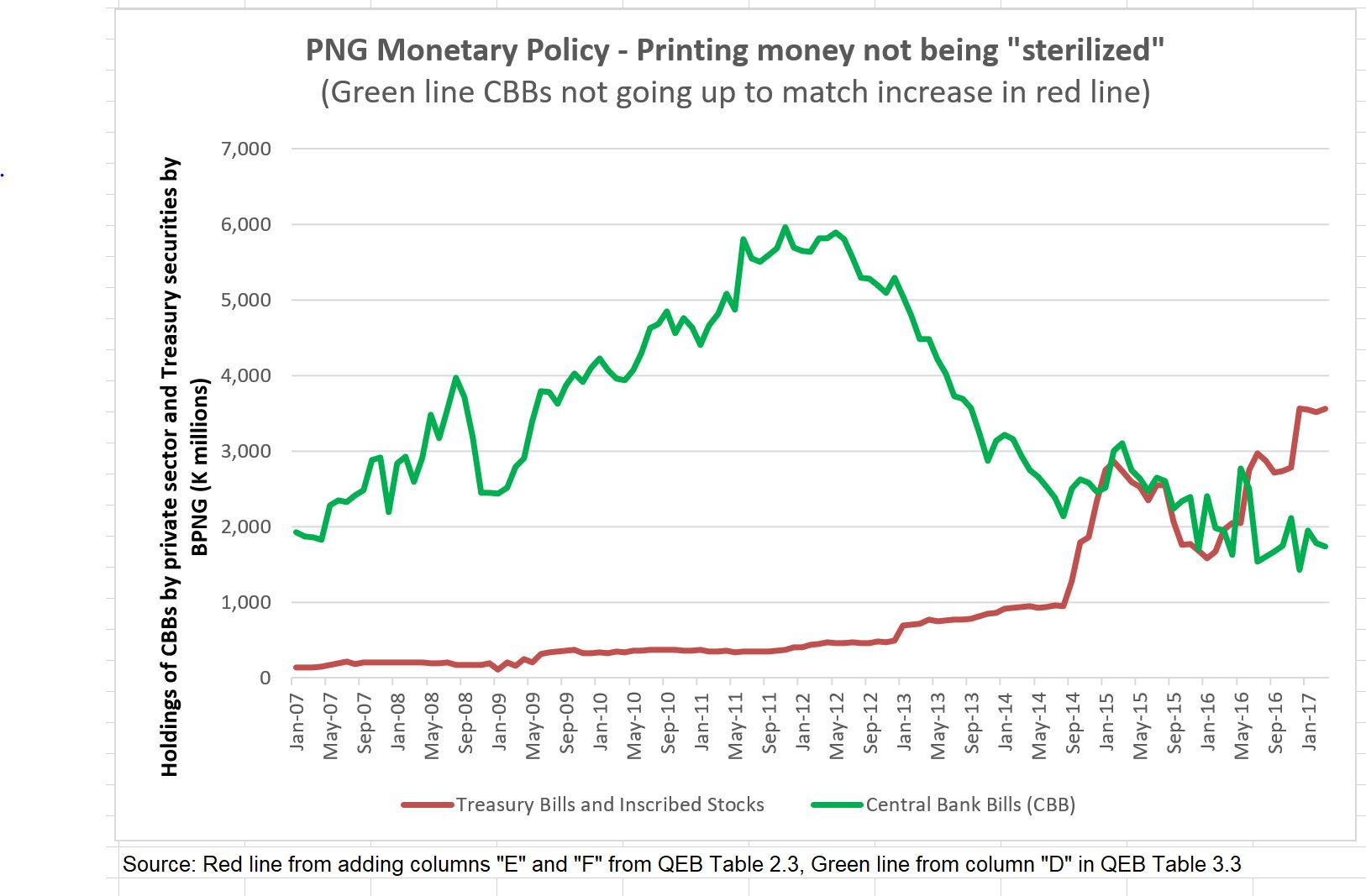
The following chart follows a key element of PNG’s monetary policy over the last 10 years.

BPNG can help control inflationary pressures in the economy through buying and selling its Central Bank Bills (CBBs). There are other tools but these have not been actively used in recent years.

CBBs essentially take money away from the private sector (so it is no longer available for lending) and park it with BPNG. This can help remove over-heating pressures from the economy which can lead to accelerating inflation and balance of payment problems with foreign exchange shortages.

The green line going up shows “sterilization” of excess liquidity (reducing over-heating pressures). A flat green line is a neutral approach. When the green line goes down, it is the reverse of sterilisation, and increases over-heating pressures on the economy.

Appropriately, BPNG rapidly reduced its level of CBBs in response to the Global Financial Crisis in 2008 to help stimulate the economy (shown by the dip in the green line in 2008).

Also appropriately, it took excess liquidity out of the banking system during the commodity price boom and then the PNG LNG construction boom from 2009 to 2012.

BPNG started in early 2012 to release some of these funds back into the market (the green line going down). In reality, especially with Treasury Bills moving into shorter-term securities of three months, this has effectively created the space to allow PNG’s private financial institutions to swap CBBs for Treasury Bills (which was confusing monetary policy with fiscal policy objectives).

Release of CBBs effectively has been a major source of funding from the private sector for the government’s historically high budget deficits.  And these high deficits can also tend to over-heat the economy.

But BPNG has gone even further than creating space for the private sector to buy up government securities as the Slack Arrangement means BPNG is also directly funding the deficit.

So with that simplified technical background, what about the claim that the Slack Arrangements purchase of about K1.6 billion in government securities has been effectively sterizilised?

First, any reference to K1.6 bn only refers to the most recent period in which it has been acquiring government securities (the red line going up).

BPNG currently has, according to its detailed tables in the Quarterly Economic Bulletin Table 2.3, K3.5598 billion (at March 2017 – the latest available detailed data) in government securities.

So BPNG actually has some K2 billion more in government securities than the K1.6 billion mentioned in its latest statement.

And if BPNG is only referring to a 12 month increase in its holdings of government securities (so not the full level), one can get a K1.6 billion increase figure by only looking at the increase from March 2016 to February 2017 (so ignoring the earlier K2 billion).

Second, did the green line go up by K1.6 billion during this time to sterilise the K1.6 billion extra in the red line (as claimed by BPNG)?

No, in fact the green line fell by K0.16 billion (specifically, from K1.949 billion to K1.789 billion).

Unless there is some new information that the BPNG has not made available to the public, BPNG has not been “sterilizing” their increased holdings of government securities.

And this is putting the economy at risk by delaying needed adjustments and building pressures on foreign exchange.

Conclusion

BPNG is undermining its own credibility with deceptive statements about dealing with the side-effects from printing money.

Rather than misleading claims about “sterilisation”, the statement should have provided more information on the Slack Arrangement. Currently, it could appear as if the Slack Arrangement is an open chequebook to the government. This would undermine confidence in the PNG economy.

Yet we know that there are government cash shortages and many unpaid bills. So unless there is exceptionally poor management in distributing government cash, it would seem that there is not an open chequebook.

BPNG should be spelling out to the public and international investor markets the guidelines and limits on the Slack Arrangement and any planned exit strategy. This would be a better way to build confidence.

BPNG – you have a proud history and you can do better for the people of PNG.

PNG’s Sept 17 Monetary Policy Statement (1) – Deceptively denying foreign exchange shortages

Summary

The good news is that PNG’s inflation rate is falling.  Good progress continues on financial inclusion initiatives and technical improvements in the banking system.

The bad news is that the September 2017 Monetary Policy Statement is the worst for more than a decade. It is out of touch with the economic pain being felt by many people and businesses in PNG. Even worse, it tries to cover up its contribution to that pain.

There are three major deficiencies in this statement.  The next three articles will deal with one major deficiency at a time as each is substantive and somewhat technical.  The three deficiencies are:

  1. Deceptively denying that there is a foreign exchange shortage and blaming it on the private banks;
  2. Pretending that printing money isn’t a problem by using erroneous statistics; and
  3. Killing private sector credit growth.

This is sad news for the people of PNG. PNG needs to acknowledge its poor policy settings if it is to improve its economic prospects from being the worst in the East Asia and Pacific region – see here.

Details

The six monthly central bank Monetary Policy Statement was released on 30 September 2017.

The 14 page document follows the usual structure with two exceptions. Both of these exceptions attempt to explain the bank’s unfortunate behaviour in creating exchange rate shortages and printing money to finance the government’s budget deficit.  This is the first of three articles covering the statement.

Exchange rate shortages – BPNG effectively says businesses are lying

In an extraordinary attempt to pervert the truth, BPNG argues “The Bank’s assessment of foreign exchange market data shows that the total supply of foreign currency, including the Central Bank’s intervention, was more than sufficient to clear the outstanding daily orders in the spot market.”

In other words, there really aren’t any foreign exchange shortages.

Contrast this with the views of 100 of PNG’s CEOs where foreign exchange shortages were considered the most critical issue faced by businesses in PNG – see here.

Why is it that businesses are saying their greatest challenge is foreign exchange shortages, but BPNG says things are fine? So are PNG’s businesses are lying?  Or is BPNG now into ‘fake news’?

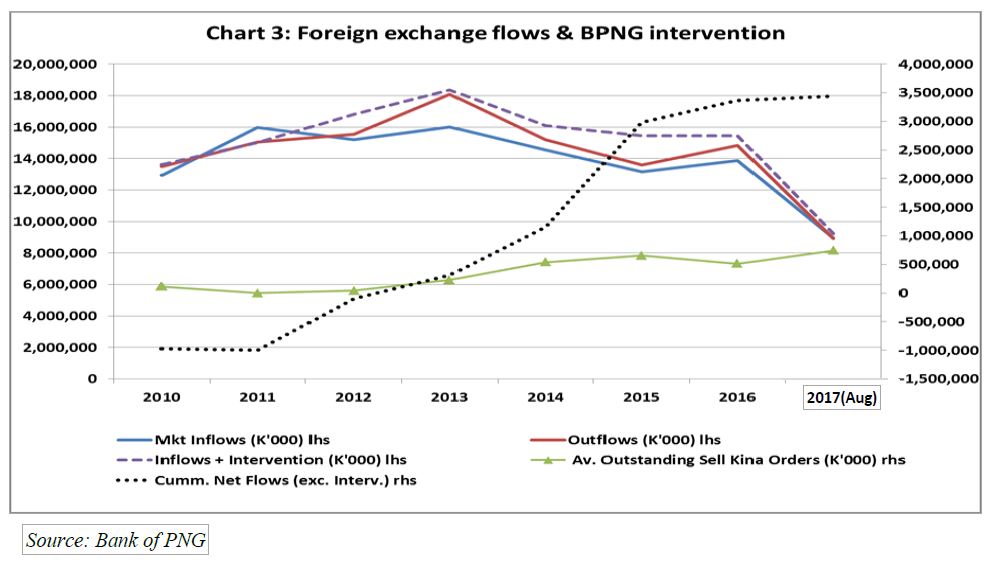
There is little information available to examine the BPNG claim.  BPNG includes the graph below.  However, it is seriously flawed.  There is no definition or source for the lines of foreign exchange inflow and outflows – they do not match Balance of Payment information such as the level of imports and exports. The cumulative balance clearly does include BPNG interventions (contrary to the legend’s description). The green line of outstanding sell orders is known to be an understatement as private banks can’t actually report all of their outstanding sell orders due to prudential limits on their reporting to the central bank. Even then, these orders have risen from essentially zero in 2012 to over K600 millionby August 2017.

And if there have been K4.5 billion in cumulative net foreign exchange flows (the dotted line starting from a minus K1 billion in 2011 to a plus K3.5 billion in August 2017) why haven’t PNG’s international reserves increased remarkably (even after netting off the interventions)?

Instead, they have fallen dramatically over that period from to K9,266 in 2011 to K5,398 million in June 2017.

So after providing a deeply flawed and misleading graph, BPNG then tries to shift any blame. They state “However, the Authorised Foreign Exchange Dealers (AFEDs) claim that the inflows are not enough to meet the demand for foreign exchange and the imbalance continues to persist. The outstanding orders by AFEDs reflect frontloading of orders, preference for serving small orders and others not backed with the required kina funds.”

So it is the private banks fault! None of the explanations are credible. For example, why is there a problem having a “preference for serving small orders” (which is arguably a good thing rather than just looking after big businesses)?

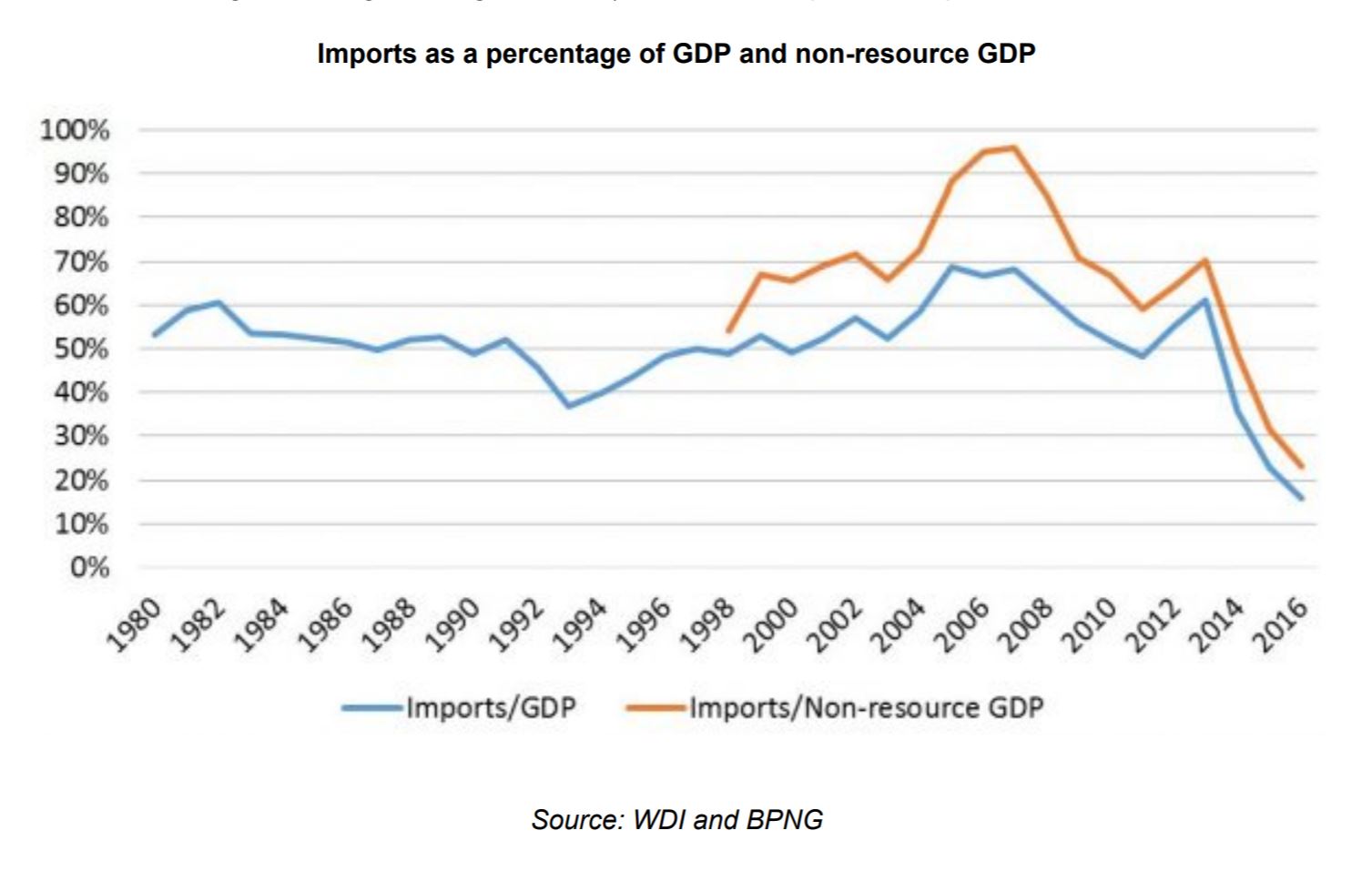
BPNG’s foreign exchange actions have already reduced PNG’s imports to only half previous levels in absolute nominal terms and even less in terms of the economy. The following graph from an excellent paper at the UPNG Economic Update in August – see here – illustrates that this killing of PNG’s imports is the most dramatic in PNG’s history. For example, the major currency crisis that led to the floating of the Kina back in 1994 appears as only a small downward blip relative to the collapse since BPNG started fixing the exchange rate and moving away from a freely convertible currency in 2014.

BPNG’s actions continue to descend down this slippery slope with the April 2017 banning of trade financing. This is an extreme anti-small business approach.

No option of trade financing means small businesses can’t continue for that crucial period between placing an order and being able to actually sell the product. Big businesses can cover this cash flow gap but smaller ones often cannot.

This banning of trade financing is a devastating policy for SME’s that are trying to start up new businesses.

Such actions by BPNG on destroying imports and banning trade financing are a growing reason for PNG’s forecast economic performance being the worst in the entire East Asia and Pacific region.

Conclusion

The latest Monetary Policy Statement from the Bank of PNG uses misleading statistics to cover up serious policy flaws in the conduct of monetary policy.

Denying foreign exchange shortages is foolish.

Blaming any shortfalls on the private banks is simply playing games.

And the actions to stifle imports hurts growth, stopping dividend payments kills foreign investment, and banning trade financing seriously hurts small and medium sized enterprises.

If one cannot accept that there is a real world issue, then one cannot start finding solutions. The first step forward is to acknowledge that there is a problem. BPNG is in a fantasy land but one that is having very adverse real world implications.

BPNG, you are killing growth in PNG.

PNG’s budget strategy not yet credible

The World Bank recently released its update on economic prospects for countries in the East Asia and Pacific region – see here. This is the second of two parts analysing that report.

The Budget – more credibility required

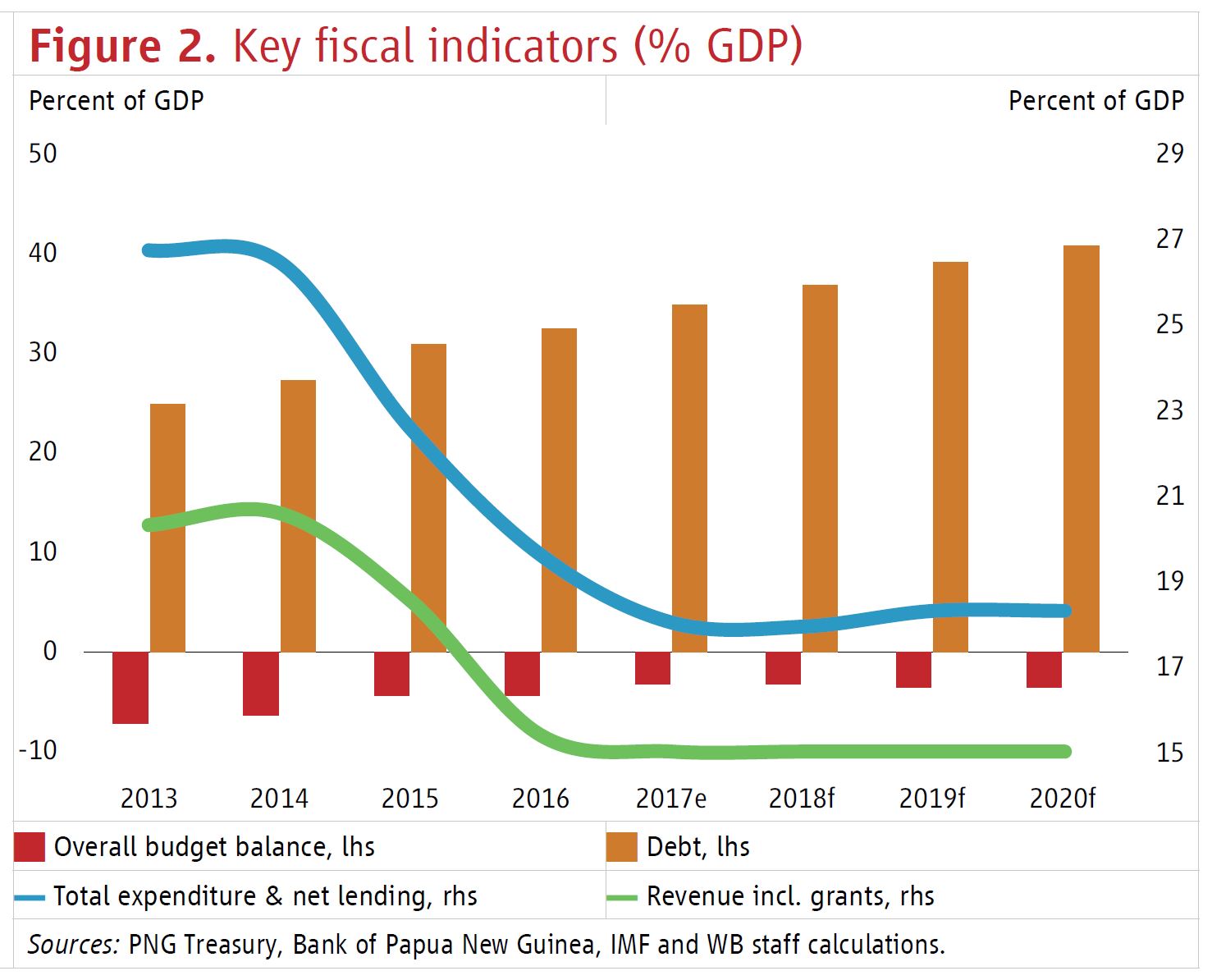
After reviewing the Supplementary Budget, the World Bank estimates that the deficit will not be 2.5% of GDP  in 2017 but 3.2%. This is in line with the IMF’s earlier expectation of the deficit being just over 3%.

The public debt to GDP ratio would be slightly under 35% by the end of 2017.

Going forward, the World Bank estimates that the deficit will fall slightly to 3.1% of GDP in 2018 and then increase to 3.5% in both 2019 and 2020.

The debt to GDP ratio is expected to climb to nearly 40% of GDP (see orange bars in graph below with the height showing as a percentage of GDP on the left hand side axis – graph from p134 of the report )

There is not much international confidence about PNG’s claimed path back to a budget surplus and reducing debt levels.

Given past experience, those concerns are justified.

Genuine budget savings are very, very difficult to deliver because of entrenched political interests in key areas such as the electorate funds to parliamentarians. PNG failed in its attempts a decade ago to make for a more efficient and effective public service. With higher public debt levels expected, interest costs will continue to rise.

The cuts in budget expenditure in recent years have already been more draconian than those imposed on Greece. And the report actually indicates that PNG needs to spend much more on basic services to improve PNG’s worst rating in the region on the Human Development Index (see table B1.C.4.1 on p67)

Much more needs to be done on the revenue side.  The best way to get revenues up is to get growth going again. In addition to better pro-growth policies, there will be a need to look at either raising tax rates or introducing new taxes.

Conclusion

Yet another outside umpire is extremely worried about the health of the PNG budget.

There is a need for some tough medicine.

The 2018 Budget, due to be delivered in a month’s time, will hopefully turn around the current negative perceptions. But this will require much more whole-of-government unity than shown in the Supplementary Budget – see here.

I still hope Charles Abel, the new Treasurer and Deputy Prime Minister, can perform a miracle and get his Prime Minister to accept that real change is needed after the economic mismanagement of the previous five years.

PNG – East Asia’s worst economic prospects

The World Bank recently released its update on economic prospects for countries in the East Asia and Pacific region – see here. This is the first of two parts analysing that report.

The growth prospects story

There was some very sad news for the people of PNG.

PNG, for every year from 2017 to 2019, is expected to have the worst economic performance in the region (see table below from p30 of the report– I’ve highlighted in yellow the growth figure for PNG which is the lowest in each of the columns).

PNG is coming last.

And with economic growth of 2.1 to 2.5% and population growth of 3%, it means that the economy is going backwards in per capita terms .

Since the last report 6 months ago, experts at the World Bank have taken off 0.9% from growth expectations for 2017, and a further 0.7% off growth in 2018.

These major cuts in growth expectations come after the new O’Neill government has released its Alotau Accord II, its 100 day plan and the Supplementary Budget.

It is a very negative vote about those new policies.

PNG’s “moderate” growth rate in the non-resource sector is expected “due to the expected on-going shortage of FX (foreign exchange) and continued fiscal consolidation.”

In my next blog on the recent BPNG Monetary Policy Statement, I’ll explore further the extremely adverse impact of these foreign exchange restrictions (and how BPNG is trying to cover these up).

Ironically, when the engine of growth dies in an economy, so do inflationary pressures.  So inflation is now expected to drop to only 4.1% in 2017.  BPNG still expects 6.0%.

So after high rates of growth flowing from the PNG LNG project (PNG had the best growth rate in the region in 2015) there is no wind left to power the PNG economy.

PNG is much too resource dependent. It needs to diversity its economy, especially towards building on its agricultural potential which would provide much more inclusive growth.

Conclusion

Yet another outside umpire is extremely worried about the health of the PNG economy.

There is a need for a new direction in economic development policy. One suggestion for a way foward, based on analysis of the last 40 years, is here (and here for Tok Pisin version).

This people-centred version of development is not simply about doing more in agriculture or tourism. Doing things in these areas must be done in an inclusive way.

Current trade policy and sectoral policies suggest the government is looking after a few mates rather than truly being inclusive. Creating high import barrier wars just ends up hurting consumers.  PNG’s own experience with Ramu Sugar indicates this is a failed form of development.

In the long-term, that will harm growth prospects.

Charles Abel, the new Treasurer and Deputy Prime Minister, needs to be very careful about what advice he listens to in trying to find a real way forward for the people of PNG.

Hopefully, in five years, PNG will have the best performing growth figures in the region with that growth coming from areas other than mining and LNG.